
Unpaid invoices from Gunzilla GmbH – What contractors and freelancers can do
- (aktualisiert am )
- 9 Min. Lesezeit

Rechtsanwalt
Jobst Ehrentraut
Inhaltsverzeichnis
- Step 1: Lawyer's demand letter (anwaltliches Aufforderungsschreiben)
- Step 2: Court order for payment (Mahnbescheid)
- Step 3: Enforcement order (Vollstreckungsbescheid)
- Step 4: Court action (Klage)
- Step 5: Enforcement of the title (Zwangsvollstreckung)
- Worked example: EUR 15,000 invoice, six months overdue
- Practical advice for contractors
- Contact
- Weiterführende Informationen
Our firm is currently receiving an increasing number of enquiries from freelancers, software developers and other contractors concerning outstanding invoices with Gunzilla GmbH, Frankfurt am Main. Many of them are based outside Germany and ask the same question: what can I do, how long does it take, and what does it cost?
This article sets out the five steps available under German law for collecting an undisputed B2B invoice, and shows the costs using a worked example of a EUR 15,000 invoice that has been overdue for six months. It is general information, not advice on an individual case. Whether a claim is well-founded and which step makes sense depends on the contract, the correspondence and the debtor's situation.
Step 1: Lawyer's demand letter (anwaltliches Aufforderungsschreiben)
The first step is a formal demand letter from a German lawyer, setting a short payment deadline (typically 7 to 14 days) and announcing court proceedings. Between businesses, the debtor is in default at the latest 30 days after receipt of the invoice (Sec. 286 (3) German Civil Code, BGB), so the letter does not create default; it documents it and gives the debtor a last chance to pay without court costs.
From the date of default, the creditor is entitled to:
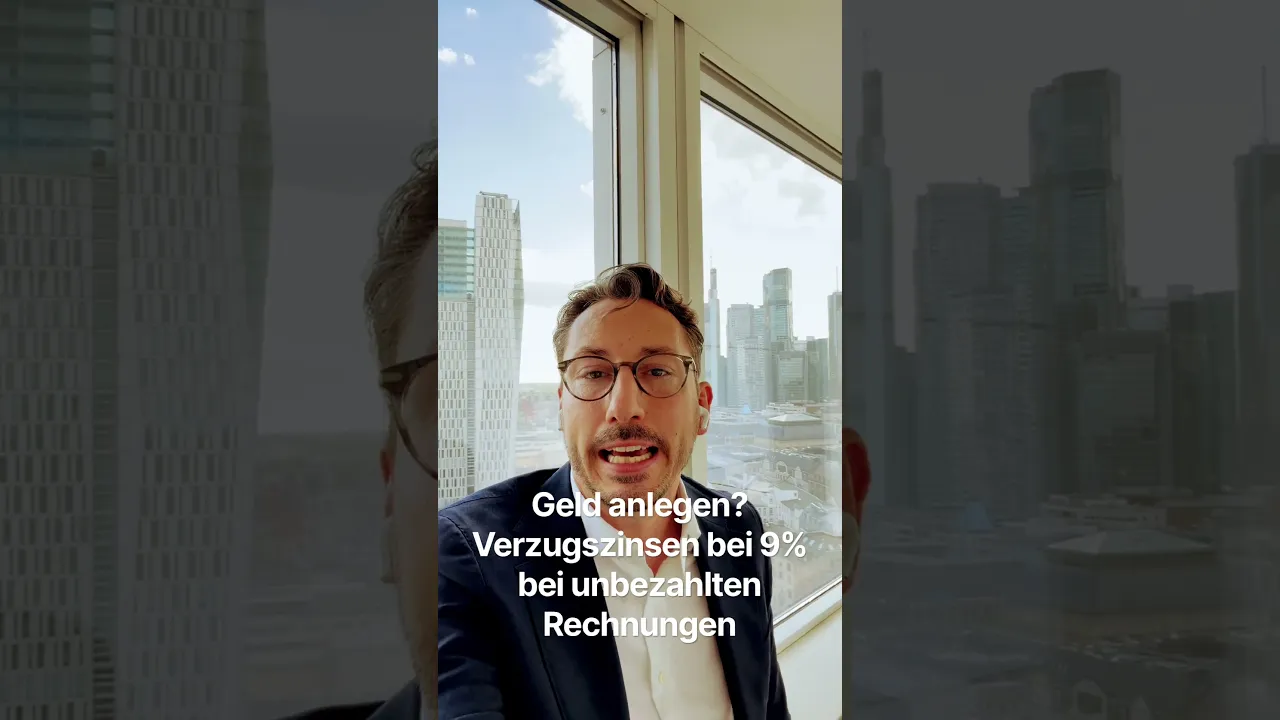
default interest of 9 percentage points above the German base rate (Sec. 288 (2) BGB), currently 10.52 % p.a.;
reimbursement of reasonable legal costs incurred after default, including the lawyer's fee for the demand letter (Secs. 280, 286 BGB).
In practice, a substantial share of undisputed invoices is paid at this stage, because the debtor can see that the next step will add court and lawyer fees to the amount owed.
Step 2: Court order for payment (Mahnbescheid)
If the debtor does not pay, the fastest route is the German order-for-payment procedure (Mahnverfahren). The application is filed electronically with the central court (for debtors in Hesse: Amtsgericht Hünfeld). The court does not examine whether the claim is justified; it issues the Mahnbescheid on the basis of the creditor's statement and serves it on the debtor.
The debtor then has two weeks to pay or to object (Widerspruch). If the debtor objects, the matter moves to Step 4 (court action); the fee already paid for the Mahnverfahren is credited against the court fee for the action.
For creditors based in another EU member state, the European Order for Payment (Regulation (EC) No 1896/2006) is an alternative with the same effect. The competent court for all applications against German debtors is Amtsgericht Wedding in Berlin. The resulting title is enforceable throughout the EU (except Denmark) without a separate declaration of enforceability.
Typical duration: 4 to 8 weeks from filing to an enforceable title if the debtor does not react.
Step 3: Enforcement order (Vollstreckungsbescheid)
If the debtor neither pays nor objects within two weeks, the creditor applies for an enforcement order. The court issues it without any further hearing. The Vollstreckungsbescheid is an enforceable title equivalent to a judgment (Sec. 700 German Code of Civil Procedure, ZPO).
The debtor can still lodge an objection (Einspruch) within two weeks of service. Unlike the Widerspruch in Step 2, this does not stop enforcement automatically: the creditor may already start enforcement measures, and the debtor would have to apply to the court to suspend them.
No additional court fee arises for the enforcement order.
Step 4: Court action (Klage)
If the debtor objects to the Mahnbescheid or Vollstreckungsbescheid, or if the claim is likely to be disputed from the outset, the creditor files a court action. For claims above EUR 5,000 the Regional Court (Landgericht) is competent; representation by a lawyer is mandatory there. Jurisdiction normally lies at the debtor's seat, i.e. for Frankfurt debtors at Landgericht Frankfurt am Main.
For contractors based abroad, three practical points matter:
The contract language and governing law clause determine whether German law applies; most service agreements with German companies provide for German law and German courts.
Non-EU claimants may be ordered to provide security for the defendant's costs (Sec. 110 ZPO) unless an exemption applies. EU residents are exempt.
The court fee (3.0 fees under the Court Costs Act, GKG) must be paid in advance before the action is served.
The losing party bears the court fees and the statutory lawyer's fees of the winning party (Sec. 91 ZPO). Duration: typically 6 to 12 months at first instance, often shorter where the debtor does not substantively dispute the invoice.
Step 5: Enforcement of the title (Zwangsvollstreckung)
A Vollstreckungsbescheid, a judgment or a European Order for Payment is enforced by the creditor, not by the court of its own motion. The main measures against a GmbH are:
Bailiff order (Gerichtsvollzieher): attachment of movable assets at the company's premises and, above all, a compulsory statement of assets (Vermögensauskunft) to be given by the managing director under oath-equivalent conditions. If it is refused, the bailiff can obtain bank account data from the tax authorities (Sec. 802l ZPO) and the company is entered in the public debtor register.
Attachment of bank accounts and receivables (Pfändungs- und Überweisungsbeschluss): the enforcement court orders the debtor's bank, or a customer of the debtor, to pay the attached amount directly to the creditor (Secs. 829, 835 ZPO). This is usually the most effective measure once an account is known.
Insolvency petition as a last resort: a creditor with an enforceable title and no payment can file for the opening of insolvency proceedings (Sec. 14 Insolvency Code, InsO). This is a pressure tool rather than a collection tool and should be used with care.
All enforcement costs, including the statutory lawyer's fees for each measure, are added to the claim and recovered from the debtor (Sec. 788 ZPO). Whether enforcement actually yields payment depends on the debtor's solvency; a title is not a guarantee of payment.
Worked example: EUR 15,000 invoice, six months overdue
Assumptions: B2B invoice for services, EUR 15,000, due on 12 April 2026, unpaid on 12 October 2026, undisputed. All figures are based on the statutory fee tables in force since 1 June 2025 (RVG, GKG) and the base rate published by the Deutsche Bundesbank. Lawyer's fees are shown net; German VAT of 19 % applies to clients in Germany, whereas business clients in other EU countries are invoiced net under the reverse-charge mechanism.
Default interest
The statutory B2B default rate is 9 percentage points above the base rate (Sec. 288 (2) BGB). The base rate was 1.27 % until 30 June 2026 and is 1.52 % since 1 July 2026, giving 10.27 % and 10.52 % p.a.
Period | Days | Rate p.a. | Interest |
|---|---|---|---|
13 Apr – 30 Jun 2026 | 79 | 10.27 % | EUR 333.40 |
1 Jul – 12 Oct 2026 | 104 | 10.52 % | EUR 449.62 |
Total after 6 months | 183 | EUR 783.02 |
Interest continues to accrue at about EUR 4.32 per day until payment.
Lawyer's and court fees by step
Fee basis: value of EUR 15,000 → statutory 1.0 lawyer's fee EUR 762.00 (Annex 2 RVG), statutory 1.0 court fee EUR 344.00 (Annex 2 GKG).
Step | Lawyer's fee (net) | Court / bailiff fee | Who ultimately bears it |
|---|---|---|---|
1 Demand letter | 1.3 fee No. 2300 VV RVG: EUR 990.60 + EUR 20.00 expenses = EUR 1,010.60 | none | Debtor, as damage caused by default |
2 Mahnbescheid | 1.0 fee No. 3305 VV RVG: EUR 762.00 | 0.5 fee No. 1100 KV GKG: EUR 172.00 | Debtor |
3 Vollstreckungsbescheid | 0.5 fee No. 3308 VV RVG: EUR 381.00 | none | Debtor |
4 Court action (if contested) | 1.3 fee No. 3100 + 1.2 fee No. 3104 VV RVG: EUR 1,905.00 + EUR 20.00 = EUR 1,925.00 | 3.0 fee No. 1210 KV GKG: EUR 1,032.00 (advance; Step 2 fee credited) | Losing party |
5 Enforcement, per measure | 0.3 fee No. 3309 VV RVG: EUR 228.60 + EUR 20.00 = EUR 248.60 | approx. EUR 50–100 (bailiff, court, service) | Debtor |
The fees are not simply added up. The fee for the demand letter is credited at 0.65 against the fee for the Mahnbescheid or the court action, and the Mahnbescheid fee is credited against the fee for the court action if the matter proceeds to trial. The court fee for the Mahnverfahren is likewise set off against the court fee for the action.
Two typical outcomes
Uncontested route (Steps 1, 2, 3 and one enforcement measure): the debtor ends up owing the EUR 15,000 principal, roughly EUR 780 in interest after six months, about EUR 2,000 in lawyer's fees after crediting, and about EUR 250 in court and bailiff costs. The creditor advances the court fee of EUR 172 and the lawyer's fees, and recovers them from the debtor together with the claim.
Contested route (Steps 1, 2 and 4, judgment in the creditor's favour): the creditor advances EUR 1,032 in court fees and own lawyer's fees of roughly EUR 2,400 after crediting. On a full win, the debtor must reimburse all of this plus the creditor's interest. If the claim is only partly successful, the costs are split in proportion (Sec. 92 ZPO).
Practical advice for contractors
Keep the paper trail. Contract, purchase order or e-mail confirmation, deliverables, time sheets, invoice and all reminders. For undisputed invoices this is usually all that is needed.
Do not wait. Interest accrues, but the longer an invoice remains unpaid, the greater the risk that the debtor's financial situation deteriorates. Claims for services are time-barred after three years from the end of the year in which they fell due (Secs. 195, 199 BGB); a Mahnbescheid or court action suspends the limitation period.
Check the debtor first. Before investing in court proceedings, a look at the commercial register, the insolvency register and the public debtor register shows whether enforcement is realistic.
Group claims where sensible. Several contractors with claims against the same debtor can coordinate, which reduces cost per creditor and increases pressure, provided each claim is pursued on its own merits.
Foreign creditors can act from abroad. None of the five steps requires the creditor's presence in Germany. A power of attorney and the original documents by post are sufficient.
Contact
We represent freelancers, agencies and companies in Germany and abroad in collecting B2B receivables from German debtors, from the first demand letter through enforcement. If you have an outstanding invoice with a German company, you can send us the contract, the invoice and the correspondence for an initial assessment.
Jobst Ehrentraut, Rechtsanwalt, Partner Tietze Enders & Partner mbB – tes legal · Rechtsanwälte Bleichstraße 64–66, 60313 Frankfurt am Main T +49 69 25 75 156 20 · ehrentraut@tes-partner.de · www.teslegal.de
This article provides general information on German law as of October 2026 and does not constitute legal advice for an individual case. Fee and interest figures are illustrative and based on the statutory tables in force at the date of publication; the actual amounts depend on the value and course of the individual matter. Statements about Gunzilla GmbH are limited to the fact that our firm receives enquiries concerning outstanding invoices; no statement is made about the merits of any individual claim or about the company's financial situation.
Weiterführende Informationen
Auf teslegal.de
Weitere Rechtstipps zum Thema
- Abmahnung wegen Nutzung von 2ix2 oder 2ix2.tv: So gehen Sie vor
- Blau machen mit Dr. Holiday - Krankschreibung und die Gefahr der Abmahnung
- Was tun, wenn der Kunde nicht zahlt?
Sie haben offene Forderungen? Über www.teslegal.de/go/inkasso-anfrage erhalten Sie je nach Kapazität eine kostenlose, unverbindliche Ersteinschätzung. Alternativ buchen Sie eine ausführliche Erstberatung mit einem Anwalt für 249,90 € brutto.

Kontakt: Telefon 069 25 75 156 20 · E-Mail erstkontakt@tes-partner.de · Web www.teslegal.de
Autor: Rechtsanwalt Jobst Ehrentraut, tes legal, Frankfurt am Main
Foto(s): tes legal
Jetzt Kontakt aufnehmen!

Weitere Rechtstipps von Jobst Ehrentraut

Zahlt der Schuldner trotz Vollstreckungsbescheid nicht, kann der Gläubiger die Zwangsvollstreckung einleiten. Der Vollstreckungsbescheid ist ein Vollstreckungstitel. Die wichtigsten Schritte sind…
Ein Mahnbescheid hemmt die Verjährung, sobald er dem Schuldner zugestellt ist. Geht der Antrag noch vor Ablauf der Verjährungsfrist beim Mahngericht ein und wird der Mahnbescheid demnächst…
Zahlt ein Kunde die Handwerkerrechnung nicht, sollten Handwerksbetriebe zuerst prüfen, ob die Vergütung fällig ist. Beim Werkvertrag wird sie erst mit der Abnahme fällig. Danach folgen Mahnung,…
Beiträge zum Thema
FOR CREDITORS BASED OUTSIDE GERMANY · UPDATED JULY 2026You delivered the work – the website, the app, the IT project, the design – on time and to spec. The client confirmed everything. Then the…
One advantage of doing business with German companies is the generally reliable legal system. If a business partner or client in Germany doesn't pay, it's not the end of the story. There are clear…
Am 03.12.2024 um 09.00 Uhr wurde das Insolvenzverfahren über das Vermögen der BLW Landeswerke GmbH, Landshuter Straße 20-22, 85716 Unterschleißheim, eröffnet. Das Amtsgericht München hat das…