
Checking Your Lease Before Moving In: Sign a Rent That's Too High and Rely on the Mietpreisbremse Later?
- (aktualisiert am )
- 15 Min. Lesezeit
- (1)

Rechtsanwalt
Dr. Armin Rothemann
If a rent looks too high but you're worried that raising it with the landlord will cost you the apartment, signing first and invoking the Mietpreisbremse afterward is legally possible — signing a lease doesn't make you lose your rights under the Mietpreisbremse. But it's not a safe strategy: before signing, you typically don't know the Vormiete, any modernization history, or other facts that can change the legal picture, and a later rent reduction is never guaranteed. The practical takeaway is to preserve all available information about the apartment during the search — listings, correspondence, the Exposé — without raising the Mietpreisbremse directly with the landlord during the application phase, and to only rent a place you could actually afford even if the rent is never reduced.
Inhaltsverzeichnis
- Can I tell before moving in whether the rent is too high?
- Why is it often impossible to reliably assess the Mietpreisbremse before signing?
- Can I sign the lease and assert the Mietpreisbremse later?
- Should I raise the Mietpreisbremse with the landlord before signing?
- What data and documents should I preserve during the apartment search?
- Why can emails and messages with the landlord matter?
- Should I ask the landlord about missing information before signing?
- What questions should I ask myself before deciding?
- Conclusion: An understandable idea — but not a safe strategy
Anyone apartment-hunting in Berlin or another city with a tight housing market knows the situation: after a long search, you finally find an apartment that really works. The location fits, the size fits, maybe you even have a good chance of getting approved — only the rent seems far too high.
At that point, a difficult decision process quickly begins. Is the apartment simply too expensive and should you keep looking? Or could the rent being asked violate the Mietpreisbremse? And if so: what actually happens if you sign the lease anyway and only challenge the excessive rent after moving in?
On a tight housing market in particular, this line of thinking is understandable. The alternative — raising a possibly excessive rent with the landlord already during the application phase — can have very practical consequences: if numerous other people are also interested in the apartment alongside you, the landlord may simply choose a different applicant instead.
Some apartment seekers therefore consider signing the lease first and only invoking the Mietpreisbremse afterward. Others try, even before signing, to at least roughly assess — using the Mietspiegel and the information already available — whether the rent being asked could even be permissible.
Legally, this idea isn't far-fetched: simply because a certain rent amount is agreed in the lease and the contract is signed, a tenant does not, in principle, lose their rights under the Mietpreisbremse.
However, that doesn't mean it's a safe strategy to deliberately rent an apartment you can't really afford and count on being able to reduce the rent afterward. Important information is often missing before the contract is signed. In particular, the Vormiete, possible modernizations, or statutory exceptions can mean that a rent that initially looks clearly excessive later has to be assessed differently.
This guide deals with a situation apartment seekers can genuinely find themselves in: What should I know if, before signing, I suspect the rent being asked violates the Mietpreisbremse? Is it a good idea to sign first and then "invoke" the Mietpreisbremse afterward?
Can I tell before moving in whether the rent is too high?
At least a first assessment is often possible. A lot of information about an apartment is already available from the listing, the Exposé (property brochure), or the draft lease. This includes things like living area, location, year of construction, and certain features.
In cities with a Mietspiegel, this information can often be used to at least approximately determine the range the ortsübliche Vergleichsmiete is likely to fall into. If the Mietpreisbremse applies to the apartment, the rent for a new tenancy generally may not exceed the ortsübliche Vergleichsmiete by more than ten percent.
A significant gap between that figure and the rent being asked can therefore already be a warning sign, even during the apartment search, that the agreed rent might be excessive.
That said, this isn't yet a complete Mietpreisbremse assessment. Apartment seekers often simply don't have, at this stage, the information that matters most for possible exceptions.
Why is it often impossible to reliably assess the Mietpreisbremse before signing?
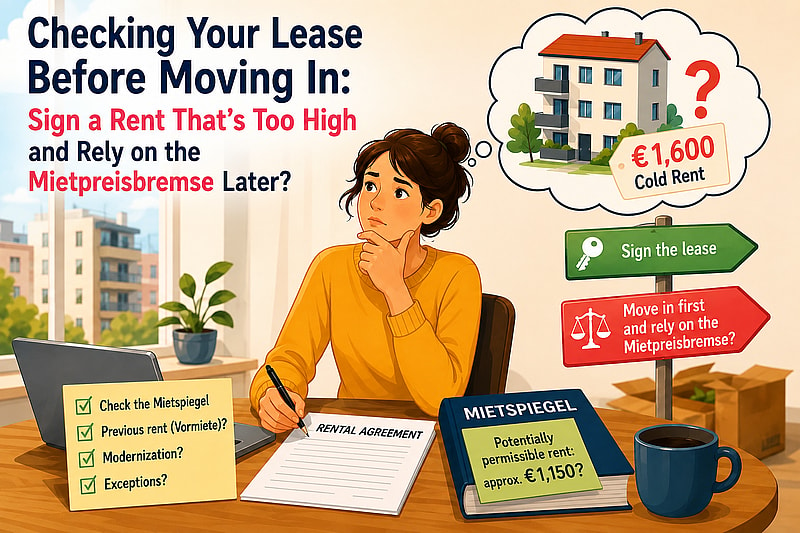
A simple example illustrates this. An apartment is offered at 1,600 euros nettokalt (net cold rent). Based on the Mietspiegel and the known features of the apartment, you initially conclude that the permissible rent might be considerably lower.
For apartment seekers, that can make a substantial economic difference. At the same time, they may not know the previous Vormiete. They don't know exactly what modernization work was carried out. Information relevant to the apartment's Mietspiegel classification may also be missing.
This creates a real dilemma: the more information you gather before signing, the more reliable your assessment could become. But anyone who sends the landlord a detailed set of questions about the Mietpreisbremse risks worsening their chances of getting the apartment in a competitive housing market.
That's why two things should be kept separate: it can make sense to preserve and evaluate, for your own decision-making, the information that's already available anyway. It's something else entirely to open up a dispute with the landlord over the permissible rent amount before the contract is even signed.
Can I sign the lease and assert the Mietpreisbremse later?
In principle, tenants don't lose their rights under the Mietpreisbremse simply by signing a lease that states a particular rent. This is essential to how the Mietpreisbremse works — it's specifically meant to cap the permissible rent for certain new tenancies. An otherwise impermissibly high rent doesn't become permissible just because it was agreed in a signed lease.
That doesn't mean, though, that every rent that seems high can actually be reduced after moving in. The Mietpreisbremse has to apply to the apartment, the permissible rent amount has to actually be exceeded, and no exception justifying a higher rent may apply. In addition, tenants generally have to assert their rights themselves — the rent doesn't automatically go down after moving in.
Should I raise the Mietpreisbremse with the landlord before signing?
This is one of the trickiest practical questions. For the most accurate legal assessment, it would help to learn as much as possible, before signing, about the Vormiete, possible modernizations, and other relevant circumstances.
But for the apartment search itself, deliberately raising the Mietpreisbremse or a possibly impermissible rent with the landlord during the application phase can pose a real risk.
Especially in Berlin and other tight housing markets, attractive apartments often have a great many interested applicants. Anyone who tells the landlord they might consider the rent being asked unlawful, asks detailed questions about the Mietpreisbremse, or even signals that they might challenge the rent after signing has to expect that they simply won't get the apartment at all.
As long as no lease has been signed yet, the landlord can often simply choose a different applicant instead.
That's the practical downside of assessing things before signing: the information that would make a legal assessment more reliable is often held by the landlord. But asking for it in a way that clearly signals a rent-law background can worsen your position in the application process.
Evaluating available information for yourself before signing is therefore something quite different from already starting a dispute over the rent amount before signing.
What data and documents should I preserve during the apartment search?
Regardless of how you ultimately decide, it can make sense to keep the information about the apartment that's already available to you anyway.
This matters partly because information can disappear once the lease is signed. The property listing gets taken down, messages in the property portal may no longer be accessible later, and details from the application phase don't necessarily show up again in the lease itself.
In particular, it can be worth:
Saving the complete apartment listing as a PDF or screenshot. Of particular interest are the rent amount, living area, year of construction, location, and details on fittings.
Keeping the Exposé and the draft lease. Earlier versions of the contract can also be relevant later.
Preserving emails with the landlord, Hausverwaltung, or estate agent.
Saving messages from property portals separately, outside the portal itself.
Documenting any available information about the Vormiete.
Keeping statements about modernization, refurbishment, renovation, or Kernsanierung.
Preserving photos from the listing and from the viewing.
Noting any recognizable features of the apartment that could be relevant for the applicable Mietspiegel.
Keeping any other Exposés, information sheets, and documents about the apartment.
Making notes of individual in-person meetings or phone calls.
This takes some effort during the apartment search. Months or years later, the same information can be much harder — or impossible — to reconstruct.
Why can emails and messages with the landlord matter?
Communication before signing, in particular, can contain information that never appears in the later lease at all.
The landlord might, for example, state by email that the apartment was "fully modernized" or given a "Kernsanierung." Or explain that even the previous tenants paid a similarly high rent.
Such statements don't automatically mean the landlord is legally entitled to charge a higher rent. An apartment marketed as "kernsaniert," for example, doesn't meet the statutory requirements for a comprehensive modernization merely because of that label.
But the communication can document what the landlord stated themselves, and which actual circumstances they might later rely on.
That's why it can make sense to preserve not just the lease itself, but the entire digital record surrounding the rental.
Should I ask the landlord about missing information before signing?
There's no one-size-fits-all answer here. From a legal standpoint, additional information can be extremely valuable — the Vormiete and any earlier modernization work, in particular, can significantly affect the permissible rent.
At the same time, the practical problem already described remains. Anyone who, during a competitive apartment allocation, asks a lengthy set of questions about the Vormiete, modernization, and the Mietpreisbremse can worsen their chances of getting the apartment.
That's why information gaps can remain before signing. This uncertainty shouldn't be ignored when making your own decision. An apartment that appears clearly overpriced based on the known data may need to be assessed differently once further facts become known.
Risk 1: An unknown Vormiete can change the calculation
The Vormiete is one of the most important sources of uncertainty. Under certain statutory conditions, a higher rent that was already lawfully owed before can affect what rent is permissible in the new tenancy.
Someone who doesn't know the Vormiete may therefore initially arrive, based on the Mietspiegel, at a considerably lower figure — even though the landlord might later invoke a higher Vormiete.
The gap between the asking rent and a roughly calculated Mietspiegel rent is therefore an important warning sign — but not yet a guarantee of a later rent reduction.
Risk 2: Modernization, Kernsanierung, or new construction can play a role
The age and history of the apartment can also be decisive. Certain new buildings are subject to exceptions from the Mietpreisbremse. The first tenancy after a comprehensive modernization is also specifically regulated by law.
That said, not every description in an apartment listing should be taken at face value. An apartment isn't exempt from the Mietpreisbremse merely because it's advertised as "renovated," "refurbished," "modernized," or "kernsaniert."
Whether the statutory requirements are actually met has to be assessed separately. For the decision before signing, this means: if there are indications of relevant construction work or new construction, the legal assessment becomes less certain.
Risk 3: Even the Mietspiegel doesn't always give a clear-cut figure
Determining the ortsübliche Vergleichsmiete isn't always a simple calculation either. Depending on the Mietspiegel, location, size, year of construction, and various features can all play a role. Individual features can later become a point of dispute between landlord and tenant.
That's why it makes a significant difference whether the rent being asked is only slightly, or very clearly, above the initially calculated figure. A possible overage of 30 or 40 euros a month is assessed differently than a gap of several hundred euros.
Risk 4: A later rent reduction is not guaranteed
This is the most important point: nobody should blindly sign a lease in the confident expectation that the agreed rent can later be reduced to a specific amount.
The landlord can present information that wasn't known before signing. They can invoke statutory exceptions or dispute the calculation of the Vergleichsmiete. If it comes to a legal dispute, there's also litigation risk.
It would therefore be particularly risky to rent an apartment whose agreed rent you can't actually afford, and to build your own financing solely on the assumption that the Mietpreisbremse will later be successfully enforced.
Even with good chances of success: as the saying goes, being right and being proven right aren't always the same thing. A proceeding can, if necessary, also take many months.
Risk 5: The dispute becomes part of your relationship with the landlord
This practical consequence shouldn't be glossed over either: anyone who challenges the agreed rent after signing the lease is exercising statutory rights. Even so, this can create conflict with the landlord. With a large housing company, the personal dimension may barely matter. With a private landlord — who might even live in the same building — things can look different, and potentially become more emotional.
That doesn't change the tenant's statutory rights. But for your personal decision, it can still be a factor. In many situations, it's advisable to have the Mietpreisbremse enforced by experienced professionals. They have experience and can keep the relationship with the landlord intact through professional handling — emotions stay out of it, and the right gets enforced.
What questions should I ask myself before deciding?
Anyone who suspects, during the apartment search, that the rent on offer might violate the Mietpreisbremse can ask themselves the following questions in particular:
Does the Mietpreisbremse even apply to this apartment?
Roughly how high might the ortsübliche Vergleichsmiete be?
How far above that is the rent being asked?
What information about the apartment do I already have?
What do I know about the year of construction, new construction, and modernizations?
Is there any information available about the Vormiete?
What decisive facts am I still missing?
How large would the possible monthly difference be?
How much could my assessment change based on information I don't yet have?
What documents and communication have I already preserved?
What practical consequences would a later dispute with the landlord have?
Could I still afford the agreed rent if a later reduction doesn't succeed?
That last question, in particular, shouldn't get lost amid understandable hopes pinned on the Mietpreisbremse.
Conclusion: An understandable idea — but not a safe strategy
Anyone who has finally found a suitable apartment in a tight housing market, and at the same time suspects the rent being asked is far too high, faces a real dilemma. It's understandable that the thought arises:
"Maybe I'll just sign the lease first and deal with the Mietpreisbremse afterward."
Simply signing a lease does not, in principle, cause a tenant to lose their rights under the Mietpreisbremse.
But that shouldn't lead to the opposite conclusion — that a rent which initially looks high can definitely be reduced after moving in. Especially before signing, crucial information about the Vormiete, modernization, or other exceptions can be missing.
On top of that comes the reality of tight housing markets: anyone who raises a possibly excessive rent with the landlord already during the application phase has to expect the apartment may simply go to another applicant instead.
Anyone in this situation can therefore, above all, preserve the information already available and realistically factor the existing uncertainties into their own decision.
The Mietpreisbremse can thus already be part of your decision-making process during the apartment search. But it doesn't automatically turn a possibly overpriced apartment into an affordable one — and a later rent reduction should never be assumed to be certain before signing. Pursuing this approach is often worthwhile, but the accompanying risks need to be carefully weighed and cushioned.
FAQ
Can I sign a lease and challenge the rent under the Mietpreisbremse afterward?
Yes, in principle. Signing a lease with a given rent doesn't cause you to lose your rights under the Mietpreisbremse. But whether a reduction actually succeeds depends on facts — like the Vormiete or past modernizations — that are often unknown before signing.
Should I ask the landlord about the Mietpreisbremse before signing?
This is risky in a competitive housing market. Raising detailed questions about the Vormiete, modernization, or the Mietpreisbremse during the application phase can make a landlord choose another applicant instead, since no lease has been signed yet.
Can I already tell before moving in whether the rent is too high?
Often you can get a first rough estimate using the Mietspiegel and details from the listing, such as living area, location, and year of construction. But this isn't a full assessment — key facts like the Vormiete or modernization history are usually still missing at this stage.
What information should I save during the apartment search?
Save the full listing, the Exposé, the draft lease, and all correspondence with the landlord, Hausverwaltung, or estate agent — including anything they say about the Vormiete or modernization work. This information can disappear once the lease is signed and be very hard to reconstruct later.
Why does the Vormiete matter so much?
A previously lawful higher Vormiete can, under certain conditions, affect what rent is permissible in the new tenancy. Without knowing it, a Mietspiegel-based estimate can look more favorable than what actually turns out to be enforceable.
Does a "modernized" or "kernsaniert" listing mean the Mietpreisbremse doesn't apply?
Not automatically. An apartment isn't exempt from the Mietpreisbremse just because it's marketed as renovated, refurbished, modernized, or kernsaniert — whether the statutory requirements for an exception are actually met has to be assessed separately.
Is a later rent reduction guaranteed?
No. The landlord can raise facts that weren't known before signing, invoke statutory exceptions, or dispute the Mietspiegel calculation, and any dispute carries litigation risk. You should never rent an apartment you couldn't otherwise afford purely on the assumption that the Mietpreisbremse will succeed later.
Foto(s): ChatGPT
Jetzt Kontakt aufnehmen!

Weitere Rechtstipps von Dr. Armin Rothemann

Die Frankfurter Allgemeine Zeitung hat am 25. November 2026 ein ausführliches Porträt des Conny-Gründers Daniel Halmer veröffentlicht. Unter der Überschrift „Deutschlands Vermieterschreck“…

Wer feststellt, dass die eigene Miete möglicherweise gegen die Mietpreisbremse verstößt, möchte häufig möglichst schnell etwas dagegen unternehmen. Manche Mieterinnen und Mieter kürzen ihre…

You found an apartment in Berlin. The rent was painfully high, but so were all the other apartments you had seen. There were dozens of applicants, you needed somewhere to live, the landlord asked for…
Beiträge zum Thema
Many tenants first try to enforce their rights under the Mietpreisbremse themselves. They look at the Mietspiegel, work out a possible Vergleichsmiete, and write to their landlord explaining that, in…
Checking Your Rent Before You Sign the LeaseWhen searching for an apartment on ImmoScout24 or another property portal, most people focus on practical questions first:Is the location right?Is the…
20, 25, or even 30 euros per square meter for an ordinary apartment: especially in big cities, many tenants eventually ask themselves whether such a high rent can even be legal. In everyday language,…