
Is My Rent Too High? Rent Check, Rent Review, Berlin Rent Scan and Germany's Rent Brake Explained (2026)
- (aktualisiert am )
- 23 Min. Lesezeit
- (3)

Rechtsanwalt
Dr. Armin Rothemann
Inhaltsverzeichnis
- Checking Your Rent Before You Sign the Lease
- Can I Check an Apartment Listing on ImmoScout24 Before Moving In?
- Is an Expensive Apartment Automatically Illegal?
- What Is the Berlin Rent Scan?
- What Does the Berlin Rent Scan Actually Mean for Tenants?
- Will the Berlin Rent Scan Automatically Reduce My Rent?
- What Does "Rent Check", "Rent Review" or "Rent Scan" Actually Mean?
- Why Is It Worth Checking the Rent Before Moving In?
- Should I Raise the Rent Brake With the Landlord Before Signing the Lease?
- Can I Sign the Lease Even If the Advertised Rent Appears Too High?
- How Does Germany's Rent Brake Work?
- Does Germany's Rent Brake Apply in Berlin in 2026?
- What Information Do I Need for a Proper Rent Review?
- Which Rent Should I Compare?
- The Most Important Exceptions to Germany's Rent Brake
- Higher Previous Rent
- Newly Built Apartments
- Comprehensive Modernisation
- Other Modernisation Measures
- Temporary Accommodation
- Must the Landlord Disclose These Exceptions Before I Sign the Lease?
- Does Germany's Rent Brake Also Apply to Furnished Apartments?
- What Should I Do If My Rent Check Suggests That My Rent Is Too High?
- Can I Use the ImmoScout24 Listing as Evidence?
- How Much Rent Can I Reclaim?
- Is It Worth Enforcing My Rights?
- What Are the Risks?
- Why Do So Many Tenants Never Enforce Their Rights?
- Understanding Litigation Funding
- Getting Help with Your Rent Brake Claim
- Conclusion
Checking Your Rent Before You Sign the Lease
When searching for an apartment on ImmoScout24 or another property portal, most people focus on practical questions first:
Is the location right?
Is the apartment large enough?
Can I afford the rent?
What are my chances of getting a viewing?
One question, however, is often asked much later: Is the landlord actually allowed to charge this rent?
That can be an expensive mistake. Just because a rent is advertised openly on ImmoScout24 and attracts dozens of interested applicants does not automatically mean it is lawful. In many German cities with a tight housing market, Germany's rent brake ("Mietpreisbremse") limits the maximum rent that may be charged at the beginning of a new tenancy. This protection generally applies even if the tenant voluntarily signs the lease knowing the advertised price.
The issue has recently attracted considerable public attention through the Berlin Rent Scan ("Berliner Mietenscan"). The Berlin government automatically analysed thousands of publicly available rental listings on online property portals for possible violations of statutory rent limits. According to official figures, more than 2,000 listings were identified as potentially unlawful. In most of these cases, the suspected violation concerned Germany's rent brake.
The results show that checking the legality of a rent before moving into a property can be worthwhile. If you find an apartment on ImmoScout24, Kleinanzeigen or another property platform, you can often identify unusually high rents before signing the lease.
However, an online rent check is only a first step. Whether the rent can actually be reduced depends on the specific circumstances of the tenancy. Likewise, the Berlin Rent Scan does not automatically reduce existing rents or notify tenants that they may have legal claims.
This guide explains how to assess a rental listing before signing a lease, how Germany's rent brake works in practice, and what rights you may have if the advertised rent exceeds the legal limit.
Can I Check an Apartment Listing on ImmoScout24 Before Moving In?
Yes, you can. Even before signing a lease, a property listing often provides enough information to carry out an initial rent review. The most important information includes:
the address (or at least the neighbourhood),
the size of the apartment,
the advertised net basic rent ("Nettokaltmiete"),
the year of construction or approximate age of the building,
the planned start of the tenancy,
details about the apartment's features and condition,
whether the apartment is furnished,
references to new construction or major renovations,
and, where available, information about the previous rent.
Many of these details are already included in an ImmoScout24 listing. However, the information that matters most for determining whether a legal exception to Germany's rent brake applies is often missing. A preliminary rent check can therefore only indicate whether the asking rent appears significantly above the applicable local reference rent ("Mietspiegel") and whether further investigation is advisable.
People searching for terms such as
ImmoScout24 rent check
Germany's rent brake ImmoScout
check rent before signing a lease
rent review before moving in
are usually trying to answer one simple question: Does this rental offer look legally acceptable? A property listing alone cannot always provide a definitive answer. Nevertheless, it is often sufficient to produce a meaningful first assessment.
Is an Expensive Apartment Automatically Illegal?
No. A high rent does not automatically mean that the landlord is breaking the law. In everyday conversation, people often describe any expensive apartment as "rent gouging." Legally, however, several different rules must be distinguished.
Germany's Rent Brake
Germany's rent brake limits the rent that may generally be charged at the beginning of a new tenancy in designated areas with a tight housing market. As a general rule, the initial rent may not exceed the applicable local reference rent by more than 10%.
Excessive Rent under the German Economic Offences Act
German law also contains provisions against excessive rent under Section 5 of the Economic Offences Act ("Wirtschaftsstrafgesetz"). This requires more than simply charging a high rent.
Criminal Rent Gouging
Criminal rent gouging under Section 291 of the German Criminal Code is subject to even stricter requirements. Besides a significant imbalance between rent and value, the landlord must also exploit the tenant's particular vulnerability or difficult personal circumstances.
ImmoScout24 itself explains on its information pages that these legal concepts must not be confused. Simply charging a rent above the local average does not automatically amount to criminal rent gouging.
For mo st tenants, however, Germany's rent brake is the most important legal protection.A rent can violate the rent brake without amounting to criminal rent gouging.
What Is the Berlin Rent Scan?
The Berlin Rent Scan is an automated screening system that analyses publicly available rental listings on online property portals. Using the information contained in each advertisement, the system checks whether the advertised rent may violate:
Germany's rent brake,
Section 5 of the German Economic Offences Act,
or the criminal prohibition against rent gouging.
At this stage, the system merely identifies suspected violations. Landlords whose listings appear problematic are contacted by the authorities and asked to review the advertised rent and, where appropriate, adjust it. The Berlin government explicitly describes the Rent Scan as a preventive measure designed to identify potentially unlawful rental offers before tenants are affected. The Berlin Rent Scan should therefore not be confused with an individual legal review of a specific tenancy.
Review | What is examined? | Result |
|---|---|---|
Berlin Rent Scan | Public online rental listings | Administrative suspicion of a possible legal violation |
Online Rent Check | Information entered about a specific apartment | Initial individual assessment |
Legal Review | Lease agreement, local reference rent, legal exceptions and landlord disclosures | Assessment of possible legal claims |
Legal Enforcement | Formal notice, information requests and legal action | Rent reduction and possible repayment of overpaid rent |
What Does the Berlin Rent Scan Actually Mean for Tenants?
Does the Berlin Rent Scan Check Every Apartment Listed on ImmoScout24?
No. The Berlin Rent Scan automatically analyses publicly available rental advertisements on major property portals. However, this does not mean that every apartment listed on ImmoScout24 or another platform is fully reviewed or legally assessed.
Some listings cannot be analysed properly because important information is missing. Others involve special types of housing or legal situations that cannot be evaluated using the publicly available data alone. Most importantly, the Berlin Rent Scan only has access to the information contained in the online advertisement. It cannot know:
what is ultimately included in the lease agreement,
whether the landlord is entitled to rely on a legal exception,
whether the previous rent exceeded the normal rent limit,
or whether additional information will later become available.
For that reason, tenants should not assume that an advertised rent is lawful simply because the apartment remains online or because the authorities have not contacted the landlord. Likewise, the fact that the Rent Scan identifies a suspicious listing does not automatically prove that the tenant has a legal claim. The Berlin Rent Scan is a valuable screening tool – but it is not a substitute for an individual legal review.
Will the Berlin Rent Scan Automatically Reduce My Rent?
No. The Berlin Rent Scan does not change existing tenancy agreements. Germany's rent brake is primarily enforced through civil law. This means that tenants themselves must take action if they believe they are paying an unlawfully high rent.
Typically, this involves several steps:
reviewing the rent,
obtaining additional information from the landlord where necessary,
serving a formal notice under Germany's rent brake ("Rüge"),
and, if necessary, enforcing the claim through legal proceedings.
The Berlin Rent Scan may encourage landlords to reconsider unusually high asking rents before a tenancy begins. However, it does not automatically inform tenants who have already rented the property, nor does it automatically reduce existing rents or repay overpaid rent. If you are already living in an apartment and suspect that your rent exceeds the legal limit, you must generally assert your rights yourself.
What Does "Rent Check", "Rent Review" or "Rent Scan" Actually Mean?
These terms are often used interchangeably, but they can describe very different levels of analysis. A basic rent check usually compares the advertised rent with the local reference rent. A more advanced rent review also considers factors such as:
the age of the building,
the location,
the size of the apartment,
and its features and condition.
A full legal assessment goes considerably further. It also examines issues such as:
the previous rent,
modernisation works,
statutory exceptions,
landlord disclosures,
and other legal requirements under Germany's rent brake.
For this reason, a rent review carried out before signing a lease will usually produce one of four possible outcomes:
The advertised rent appears unremarkable.
The advertised rent may exceed the legal limit.
Additional information is required before a reliable conclusion can be reached.
A statutory exception to Germany's rent brake may apply.
A preliminary rent check can therefore be extremely useful. However, it should always be understood as an initial assessment, not as a definitive legal opinion.
Why Is It Worth Checking the Rent Before Moving In?
A rent review before signing the lease offers several practical advantages.
1. You can identify unusually high rents early.
Even if it is not yet clear whether Germany's rent brake ultimately applies, comparing the asking rent with the local reference rent provides valuable information about the financial implications of the offer.
2. You know which questions to ask the landlord.
Suppose the landlord claims that:
the apartment is newly built,
it has been comprehensively modernised,
or the previous tenant already paid a similarly high rent.
These statements may be legally relevant because they could affect the application of Germany's rent brake.
Knowing this before signing the lease allows you to request further information where appropriate.
3. You can preserve important evidence.
The online advertisement itself may later become valuable evidence.
It may document:
the advertised rent,
the apartment size,
the description of the property,
statements about furnishing,
claims that the apartment is newly built,
or references to the duration of the tenancy.
Because many listings disappear shortly after the apartment has been rented, it is usually advisable to save the advertisement as a PDF or take screenshots before it is removed.
4. You can avoid missing important deadlines.
The timing of the formal notice under Germany's rent brake can significantly affect the amount of rent that may later be reclaimed.
Depending on the circumstances, tenants may be able to recover up to 30 months of overpaid rent.
Waiting too long before reviewing the tenancy may therefore reduce the amount that can ultimately be recovered.
For that reason alone, an early rent review is often worthwhile.
Should I Raise the Rent Brake With the Landlord Before Signing the Lease?
That is ultimately a strategic decision. From a legal perspective, it can make sense to ask the landlord before signing the lease about matters such as:
the previous rent,
the age of the building,
or any major modernisation works.
If the landlord intends to rely on certain statutory exceptions, German law generally requires relevant information to be disclosed before the tenancy agreement is concluded. In practice, however, prospective tenants often face a difficult situation. In highly competitive housing markets, landlords frequently receive dozens – or even hundreds – of applications for a single apartment.
Before a lease has been signed, applicants generally have no legal entitlement to be chosen. For that reason, some prospective tenants may prefer not to challenge the advertised rent during the application process. This does not mean that tenants should conceal their rights or provide inaccurate information. It simply illustrates that the legal assessment of a tenancy and the strategic timing of raising legal questions are two separate issues. If you are uncertain, it is often sensible to:
save the property listing,
collect the available information,
and seek legal advice before deciding how to proceed.
Can I Sign the Lease Even If the Advertised Rent Appears Too High?
Yes. Simply signing a lease does not automatically prevent you from relying on Germany's rent brake later. If the agreed rent exceeds the legal limit and no statutory exception applies, the portion of the rent above the permitted level is generally unenforceable under German law.
In other words, tenants do not lose their rights merely because:
the rent was clearly stated in the online advertisement,
the amount appeared in the lease agreement,
or they voluntarily signed the contract.
However, there is one important qualification. Although a preliminary rent check may indicate that the rent is unusually high, you should not assume that a rent reduction is guaranteed. An online assessment may be incomplete. The landlord may later disclose a higher previous rent, prove that a statutory exception applies, or provide information that changes the legal assessment. For that reason, anyone renting an apartment in the expectation of reducing the rent later should first obtain a careful legal review.
How Does Germany's Rent Brake Work?
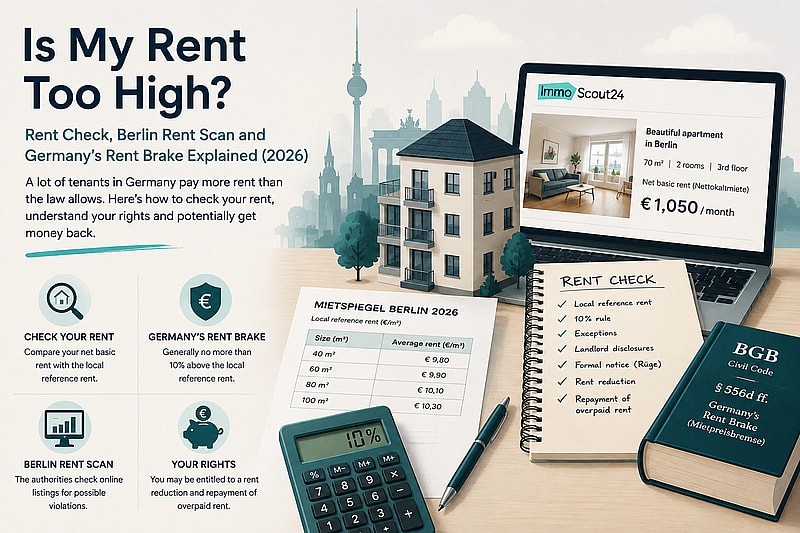
Germany's rent brake applies in designated areas with a tight housing market. As a general rule, the rent agreed at the beginning of a new tenancy may not exceed the local reference rent ("Mietspiegel") by more than 10%. A simplified example illustrates the principle. Assume the local reference rent is:
€10 per square metre
Under Germany's rent brake, the landlord may generally charge:
€11 per square metre
For a 70 m² apartment, this would result in:
70 × €10 = €700
plus 10%
= €770
If the apartment is advertised on ImmoScout24 for €1,050 net basic rent, the apparent difference is €280 per month.
Whether this difference can actually be reclaimed depends on several additional legal questions, including:
whether the local reference rent has been calculated correctly,
whether the apartment falls within the scope of Germany's rent brake,
and whether one of the statutory exceptions applies.
Does Germany's Rent Brake Apply in Berlin in 2026?
Yes. Berlin has designated its entire city as an area with a tight housing market. As a result, Germany's rent brake generally applies to new tenancy agreements for existing residential properties throughout Berlin, unless a statutory exception applies. The Berlin Rent Index ("Berliner Mietspiegel 2026") usually provides the starting point for calculating the permissible rent. Berlin also offers an official online calculator.
However, the city itself expressly states that this calculator is intended only as guidance and does not constitute a legally binding determination of the permissible rent.
The Berlin Rent Index contains numerous categories and ranges.
A city-wide average rent is therefore not automatically the correct comparison for a particular apartment.
What Information Do I Need for a Proper Rent Review?
The more information you have, the more reliable the assessment will be.
Ideally, you should collect:
the complete property advertisement,
the address and location,
the apartment size,
the advertised net basic rent ("Nettokaltmiete"),
service charges,
the year of construction,
details of any furnishing,
information about modernisation,
whether the apartment is described as newly built,
the planned start date of the tenancy,
a draft of the lease agreement,
information about the previous rent,
and any correspondence with the landlord or estate agent.
It is also advisable to save the original property listing as a PDF or take screenshots.
Many online advertisements disappear shortly after the apartment has been rented and may no longer be available later.
Which Rent Should I Compare?
The relevant figure is generally the net basic rent ("Nettokaltmiete"). The warm rent ("Warmmiete") includes service charges – and often heating costs – and therefore cannot be compared directly with the local reference rent. Property listings frequently contain several different amounts, including:
net basic rent,
service charges,
heating costs,
total monthly rent,
furniture surcharge,
parking fees,
and other flat-rate charges.
For a reliable rent review, these amounts must be separated. Where the advertisement simply states a single total amount, a more detailed legal assessment may be required.
The Most Important Exceptions to Germany's Rent Brake
Germany's rent brake is subject to several important statutory exceptions. These are often the decisive factor in determining whether a tenant actually has a legal claim.
Higher Previous Rent
If the previous tenant already paid a rent above the normal limit, the landlord may, under certain circumstances, continue charging up to that previous rent. This is one of the most important exceptions in practice. Because the previous rent is rarely disclosed in an ImmoScout24 advertisement, an offer that initially appears unlawful may ultimately prove to be permissible.
Newly Built Apartments
Germany's rent brake does not apply to apartments that were first occupied and first rented after 1 October 2014. However, simply describing a property as a "new build" in an online advertisement does not automatically satisfy the legal requirements. The decisive question is when the apartment was actually first occupied and rented.
Comprehensive Modernisation
The first letting following a comprehensive modernisation is also exempt from Germany's rent brake. However, not every renovation qualifies. For example:
a new fitted kitchen,
new flooring,
or a refurbished bathroom
do not automatically amount to a comprehensive modernisation under German law. Whether the exception applies depends on the extent and overall significance of the works carried out.
Other Modernisation Measures
Even where the works are not extensive enough to create a complete exemption, certain modernisation costs may still influence the maximum lawful rent. For that reason, any substantial refurbishment should be examined carefully.
Temporary Accommodation
Germany's rent brake may also be excluded where residential accommodation is genuinely rented only for temporary use. However, a short fixed-term lease or a furnished apartment does not automatically qualify as temporary accommodation. The decisive factor is the actual purpose of the tenancy.
Must the Landlord Disclose These Exceptions Before I Sign the Lease?
Yes – at least in many important cases. If the landlord wishes to rely on certain statutory exceptions, German law generally requires the relevant information to be disclosed before the tenant signs the lease agreement.
This applies in particular to:
a higher previous rent,
relevant modernisation works,
first occupation and first letting after 1 October 2014,
and the first letting following a comprehensive modernisation.
If the required disclosure is missing, the landlord may initially be prevented from relying on the exception until the information has been provided in accordance with the statutory rules.
For that reason, prospective tenants should not only review the rent itself but also carefully examine:
annexes to the lease,
explanatory notes,
and any statements regarding possible exceptions.
Does Germany's Rent Brake Also Apply to Furnished Apartments?
Generally, yes. Simply furnishing an apartment does not remove it from the scope of Germany's rent brake. A landlord may charge a reasonable supplement for furniture that is genuinely provided. However, this supplement cannot simply be chosen at will. Relevant factors include:
the original purchase price,
the age of the furniture,
its condition,
and its current value.
This issue is particularly important because many furnished apartments are advertised only with a single overall rent, making it difficult to distinguish between the rent for the apartment itself and the amount charged for the furniture. Temporary accommodation and certain rooms within an owner-occupied property must again be distinguished separately.
What Should I Do If My Rent Check Suggests That My Rent Is Too High?
A preliminary rent review is only the first step. Even if the asking rent appears to exceed the legal limit, this does not automatically mean that the rent can immediately be reduced or that the landlord must repay overpaid rent. Instead, the tenancy should be reviewed carefully.
This typically includes:
calculating the applicable local reference rent,
reviewing the lease agreement,
examining any statutory exceptions,
assessing the landlord's disclosures,
determining the potential amount of overpaid rent,
and deciding whether enforcing the claim is economically worthwhile.
Only after these questions have been answered can a reliable assessment of your legal position be made.
Can I Use the ImmoScout24 Listing as Evidence?
Yes. The original property advertisement may later become an important piece of evidence. For example, it can document:
the rent originally advertised,
the apartment size,
descriptions of the property's condition,
references to furnishings,
statements that the apartment is newly built,
or claims regarding modernisation.
Because many listings disappear shortly after the apartment has been rented, it is advisable to save the advertisement as a PDF or take screenshots before it is removed.
This information may later prove useful when reconstructing the circumstances under which the tenancy was agreed.
How Much Rent Can I Reclaim?
This depends on the individual circumstances of the tenancy. Where the legal requirements are met, tenants may be able to reclaim up to 30 months of overpaid rent before serving the formal notice under Germany's rent brake. In addition, overpaid rent that continues to accrue after the formal notice may also be recoverable until the rent is actually reduced. The financial significance can therefore be substantial. For example:
Monthly overpayment: €250
Up to 30 months before the formal notice: €7,500
Additional six months while the claim is being resolved: €1,500
Total overpaid rent:
€9,000
If the monthly rent is then permanently reduced by €250 and the tenant remains in the apartment for another five years, this results in an additional saving of:
€15,000
The total economic benefit in this example therefore reaches:
€24,000
Every case is different.
However, this example illustrates why many tenants underestimate the financial importance of Germany's rent brake.
Is It Worth Enforcing My Rights?
This is one of the most common questions – and often the most important one.
The answer depends on several factors, including:
the amount of the monthly overpayment,
the potential repayment,
how long you expect to remain in the apartment,
the strength of the legal claim,
and the costs and risks of enforcement.
Many tenants focus only on the repayment they might receive today. In reality, the future rent reduction is often worth even more than the repayment itself. For long-term tenants, the cumulative financial benefit can easily amount to many thousands – or even tens of thousands – of euros.
What Are the Risks?
Enforcing legal rights may involve financial risks. If negotiations with the landlord fail, court proceedings may become necessary. Possible costs include:
legal fees,
court fees,
and, if the claim is unsuccessful, the recoverable legal costs of the landlord.
For this reason, a professional assessment should always consider both:
the likelihood of success,
and the economic risks involved.
The relevant question is therefore not simply:
"Do I have a claim?"
It is also:
"Is enforcing this claim economically worthwhile?"
Why Do So Many Tenants Never Enforce Their Rights?
The answer is surprisingly simple. Most tenants do not give up because they believe the law is against them. They give up because they are worried about the financial consequences of taking legal action. Many ask themselves:
What if I lose?
Will I have to pay thousands of euros?
Do I need legal expenses insurance?
Is the possible repayment worth the risk?
These concerns are understandable.
Yet they also explain why many legitimate claims are never pursued.
Understanding Litigation Funding
Many tenants assume that litigation funding must be extremely expensive. In reality, the more important question is often: What is the alternative?
Without legal expenses insurance, tenants who pursue a claim themselves generally bear the financial risks of litigation. Litigation funding follows a different economic model. Rather than paying legal costs upfront, the litigation funder agrees – subject to the terms of the funding agreement – to finance the legal enforcement of a promising claim in return for an agreed share of the economic recovery if the claim succeeds. The idea is straightforward. Many legitimate legal claims fail not because tenants have no rights, but because they cannot – or do not wish to – bear the financial risk of enforcing those rights.
A legal claim has real economic value only if it can actually be enforced. A claim worth €8,000 is of little practical use if no one is willing or able to assume the financial risk of pursuing it. Litigation funding transforms a theoretical legal entitlement into one that can realistically be enforced.
Litigation funding therefore does not change the law.
It changes the economic circumstances under which legal rights can be exercised.
Getting Help with Your Rent Brake Claim
If you suspect that your rent exceeds the legal limit, you can start with a free rent check through RentAid, a tenant rights platform specialising in the enforcement of Germany's rent brake (Mietpreisbremse).
The rent check considers not only whether your rent may exceed the legal limit, but also:
whether Germany's rent brake applies,
whether any statutory exceptions are likely to be relevant,
how much rent may potentially be reclaimed,
how much your future rent could be reduced,
and whether legal enforcement appears economically worthwhile.
Where appropriate, legal enforcement can be carried out through specialised lawyers. For suitable cases, litigation funding may also be available, allowing tenants to pursue their rights without having to bear the financial risk themselves.
Conclusion
Finding an apartment in Germany is difficult enough. Paying more rent than the law allows makes it even harder.
The Berlin Rent Scan has shown that thousands of rental listings may exceed statutory rent limits. At the same time, it demonstrates something equally important:
Tenants cannot rely on the authorities alone.
If you suspect that your rent is too high, an individual legal review remains essential. Checking your rent before signing a lease—or shortly afterwards—can make a significant financial difference.
Depending on the circumstances, tenants may be entitled to reclaim up to 30 months of overpaid rent, recover additional overpayments made after serving the formal notice, and benefit from a permanently reduced rent going forward.
For many tenants, the question is therefore no longer:
"Is my rent too high?"
Instead, it becomes:
"How much could I save by enforcing my rights?"
A careful rent review provides the answer.
FAQ
Can I check the legality of an apartment on ImmoScout24 before signing the lease?
Yes. A property listing often contains enough information for an initial rent review, although a full legal assessment requires additional information.
Does the Berlin Rent Scan automatically reduce my rent?
No. The Berlin Rent Scan is a public screening tool. Individual tenants must generally assert their own rights under Germany's rent brake.
How much rent can I reclaim?
Depending on the circumstances, tenants may be able to recover up to 30 months of overpaid rent, together with further overpayments made after serving the formal notice.
Does Germany's rent brake apply to furnished apartments?
Generally, yes. Furnished apartments are not automatically exempt, although a reasonable furniture surcharge may be permissible.
Can I still rely on Germany's rent brake after signing the lease?
Yes. Signing the lease does not automatically waive your statutory rights.
Do I need legal expenses insurance?
Not necessarily. Depending on the circumstances, other options – such as litigation funding – may be available.
Can RentAid also help tenants with fixed-term rental contracts?
Yes. In suitable cases, RentAid works with cooperating lawyers to challenge unlawful fixed-term residential leases. Where successful, this may result in both the conversion of a fixed-term lease into an open-ended tenancy and the enforcem
Can international tenants also rely on Germany's Rent Brake?
Yes. Germany's Rent Brake protects all residential tenants, regardless of their nationality or native language. If you rent an apartment in Germany and the legal requirements are met, you may have the same rights to a rent reduction and repayment of overpaid rent as any other tenant.
Foto(s): ChatGPT
Jetzt Kontakt aufnehmen!

Weitere Rechtstipps von Dr. Armin Rothemann

Die Frankfurter Allgemeine Zeitung hat am 25. November 2026 ein ausführliches Porträt des Conny-Gründers Daniel Halmer veröffentlicht. Unter der Überschrift „Deutschlands Vermieterschreck“…

Wer feststellt, dass die eigene Miete möglicherweise gegen die Mietpreisbremse verstößt, möchte häufig möglichst schnell etwas dagegen unternehmen. Manche Mieterinnen und Mieter kürzen ihre…

You found an apartment in Berlin. The rent was painfully high, but so were all the other apartments you had seen. There were dozens of applicants, you needed somewhere to live, the landlord asked for…
Beiträge zum Thema
It rarely begins with a dispute. Experience shows that most tenancies initially proceed without any problems at all. The rent is transferred on time. The landlord rarely gets in touch. The apartment…
Anyone apartment-hunting in Berlin or another city with a tight housing market knows the situation: after a long search, you finally find an apartment that really works. The location fits, the size…
You found a job or a place at university. You survived your first encounters with German bureaucracy. And, somehow, you found an apartment. Congratulations.Now comes the next challenge: understanding…