
Online Review Law: Review Platforms Caught Between Removal Claims and Freedom of Expression – An Unresolved Dilemma
- (aktualisiert am )
- 8 Min. Lesezeit
- (8)

Rechtsanwalt
Dr. Timo Hohmuth LL.M.
The debate over online reviews is often oversimplified. Public discussion usually focuses on only two sides: businesses affected by reviews and the reviewers themselves. Businesses seek to challenge and, where appropriate, remove highly negative or reputation-damaging reviews. Reviewers invoke freedom of expression and want critical reviews to remain online. The actual situation, however, is considerably more complex.
The Role of Review Platforms
A further actor is the review platform itself. On the one hand, platforms do not wish to provide a space for falsehoods or defamation. On the other, they view their role as informing consumers and creating transparency.
This is especially evident where critical reviews are particularly important to those being informed—for example, in employer review platforms. There, platforms resist the flood of removal requests. At the same time, companies engaged in the “war for talent” have a strong interest in being portrayed positively as employers and therefore react sensitively to critical reviews, which often go far beyond the subtle language typically used in employment references and are considerably more direct.
It is also natural that reviewers may feel a stronger need to vent frustration than to explicitly praise a current or former employer. Platforms are sometimes asked by companies to disclose reviewer identities, while reviewers understandably have a strong interest in preventing this. Guaranteed anonymity is a key precondition for employer reviews—especially critical ones.
At the same time, reviewed companies have a legitimate interest in ensuring that the author of a negative review is not an unknown outsider who never worked there, or even a malicious competitor. This creates another conflict involving data protection law.
Additional Actors: Lawyers and “Removal Agencies”
Beyond reviewed businesses, reviewers, and platform operators, there are further actors: law firms asserting claims on behalf of reviewed entities, as well as non-lawyer “review removal agencies” that have entered this lucrative market. These agencies seek loopholes in case law and regulation that generally prohibit them from offering such legal services. Quite often, they are IT service providers with technical proximity to the platforms.
A New Market Around Negative Reviews
An entire market has now developed around negative reviews. Alongside law firms, there are reputation management services, SEO providers, IT service providers, and pure “removal agencies,” some of which have even relocated abroad in an attempt to avoid German enforcement. (Offering such legal services remains unlawful even when done from abroad for German clients.)
There are also countless freely accessible DIY guides and social media posts explaining how to file complaints, because despite standardized complaint processes, asserting one’s own rights is often not straightforward. Complaints filed by affected businesses are frequently ignored because they fail to precisely identify the legal violation or provide sufficient reasoning.
Many reviewed businesses also tolerate dubious reviews of every kind and publicly respond to them in hopes of reducing damage or appeasing the reviewer. This, in turn, attracts agencies that directly approach such businesses—sometimes even by phone—to offer removal services. Unlike lawyers, who are restricted by professional rules from soliciting individual mandates (“ambulance chasing”), non-lawyer agencies are not subject to the same rules. In many other respects, however, they are already operating unlawfully.
A Structural Dilemma
All of this creates a further structural dilemma. On the one hand, there are legitimate and necessary claims for the removal of unlawful reviews. On the other hand, the same procedures are sometimes used to push lawful, truthful, and critical reviews off the internet. Platform operators often navigate these opposing poles inconsistently.
The Legitimate Core: Unlawful Reviews Must Be Challengeable
It must first be emphasized that action against unlawful reviews is legally legitimate and often urgently necessary for businesses. Companies, like private individuals, must be protected against defamation, false allegations, insults, and similar attacks. It is natural that they seek legal representation, just as they would outside the internet.
The constitutional right of personality protection continues here in the form of corporate personality rights. Existing injunctive relief claims are therefore constitutionally protected. Even though review platforms are expressly intended to host criticism and negative experiences, they are not lawless spaces.
Freedom of Expression Also Has Limits
At the same time, reviewers’ freedom of expression is constitutionally protected. The difficulty usually lies in understanding or respecting its boundaries. Not every statement—and certainly not every form of wording—is protected. Outside the internet, this seems better understood than online (except perhaps in road traffic).
Platforms Profit From Reviews
Review platforms profit from the sheer number of submitted reviews. They have become quasi-systemically relevant for gastronomy, services, and labour markets. People review extensively. Some reviewers see themselves as restaurant critics, while “food influencers” often now have broader reach than the Michelin Guide. Unlike hobby gourmets or ordinary disappointed or enthusiastic customers, however, influencers are regularly well paid.
The importance of reviews is evident from the signs displayed by restaurants, hotels, doctors, and others asking customers to leave reviews. And users quickly become “Local Guides” after submitting only a handful of opinions.
The Rise of a “Deletion Industry”
Parallel to the growing importance of review platforms, a second market has emerged: review removers, deletion services, self-proclaimed “review heroes,” and similar actors. Behind these names are not only non-lawyer agencies but sometimes also law firms that have adopted catchy marketing labels in competition with those agencies. Here too, the background is the power of platforms—especially search platforms. It was not so long ago that permissible legal advertising in Germany was largely confined to the Yellow Pages.
Today, countless providers advertise the removal of negative reviews for a few euros, “without court proceedings,” or “on a success basis.” They boast of having removed thousands of reviews, as though they themselves directly delete them rather than merely filing complaints with platform operators. Some even claim no reasoning is needed or that simply forwarding a client’s objection is sufficient. Yet courts have clarified that this is essentially the maximum non-lawyers may do.
Their claimed success rates therefore appear highly doubtful when they challenge any review without legal examination or proper reasoning. This is especially inconsistent with their promises of instant “pre-checks.” Many imply that almost any bad review is vulnerable. Commercially, that may be persuasive. Legally, it is not.
Standard Tactics and the Problem of Truth
A common tactic is the blanket denial that any customer relationship ever existed, regardless of the truth. This places platforms in a difficult position and has led to judicial findings of a duty to act—obligations now also reflected in the EU’s Digital Services Act. Whether the denial is actually true often seems irrelevant.
Lawyers are professionally bound to truthfulness and may at most deny allegations for lack of knowledge. Such duties, however, do not apply to everyone else.
Platforms are put in a bind, reviewers are pushed into a defensive position, and truth recedes into the background.
Abuse of Complaint Procedures
The legal problem is not complaint mechanisms themselves, but their abusive use. It is therefore understandable that German law does not allow just any domestic or foreign agency to offer such services. Their dubious practices are often obvious from their own marketing materials. Case law on this point is clear.
Yet the conduct of platforms complaining about these practices is often contradictory. Large search engines and social media platforms allow non-lawyer removal agencies to advertise unlawful legal services on their channels, while their own review portals continue to process the resulting complaints.
Interestingly, the situation would be entirely different if an unauthorised agency tried to assert a monetary debt claim for someone else. Hardly anyone would respond to such a demand letter unless it amounted to unlawful intimidation. Even registered debt collection services or legal-tech companies with lawyer participation may generally only enforce monetary claims—not injunctive claims such as review removal demands.
Platform Complaint Systems as a Loophole
Review platforms, however, often respond to complaints despite the complainant lacking legal authorisation. This is likely because moderation is increasingly delegated to insufficiently trained AI systems, with little scrutiny of who is filing what complaint. Pragmatic and inexpensive though that may be, it creates an entry point where there should really be a bottleneck.
Legitimate claims are then mixed with flimsy attacks. Serious legal representatives and abusive actors are thrown into the same pot in public perception. Some reviewers are unfairly treated as fraudsters or defamers.
Meanwhile, some platforms monetise advertising by illegitimate deletion services, or process their complaints even when—judging by their own service descriptions—no real examination or reasoning has occurred. Yet the same platforms complain about the rise of a deletion industry and emphasise the importance of authenticity and integrity in reviews. All of this raises significant regulatory questions.
Meanwhile, we at Comclair Legal would be pleased to provide you with legal assistance.
#OnlineReviewLaw #OnlineReviews
Legal support for having unlawful reviews removed.

Foto(s): Comclair Legal
Jetzt Kontakt aufnehmen!

Weitere Rechtstipps von Dr. Timo Hohmuth LL.M.
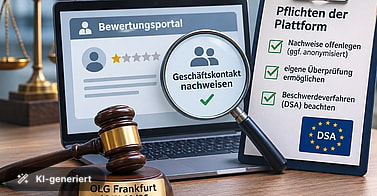
Das OLG Frankfurt a.M. hat in einem Beschluss klargestellt, dass eine bloße Bestätigung einer Bewertungsplattform bei einer Beanstandung einer Bewertung den tatsächlichen Kundenkontakt überprüft…
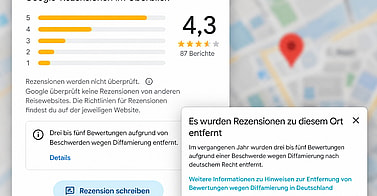
Das OLG München hat mit Beschluss vom 21.09.2026 (Az. 18 W 839/26) sich der Rechtsprechung des OLG Köln angeschlossen im Hinblick auf die Zulässigkeit des Hinweises auf die Anzahl gelöschter…

Das Landgericht Berlin II hat mit seinem Urteil vom 21.04.2026 (Az. 27 O 66/26) in Anknüpfung an die Rechtsprechung des BGH eine für das Bewertungsrecht bemerkenswerte Entscheidung getroffen und…
Beiträge zum Thema
Eine schlechte Bewertung auf Google, eine diffamierende Aussage auf einer Plattform oder gar eine gezielte Rufschädigung durch Fake-Bewertungen – für Unternehmen kann das ernste Folgen haben.…
Ungerechte Google-Bewertungen: Was Unternehmen tun können – Ein umfassender PraxisleitfadenEinleitung: Warum Google-Bewertungen heute so wichtig sindIm digitalen Zeitalter entscheiden oft wenige…